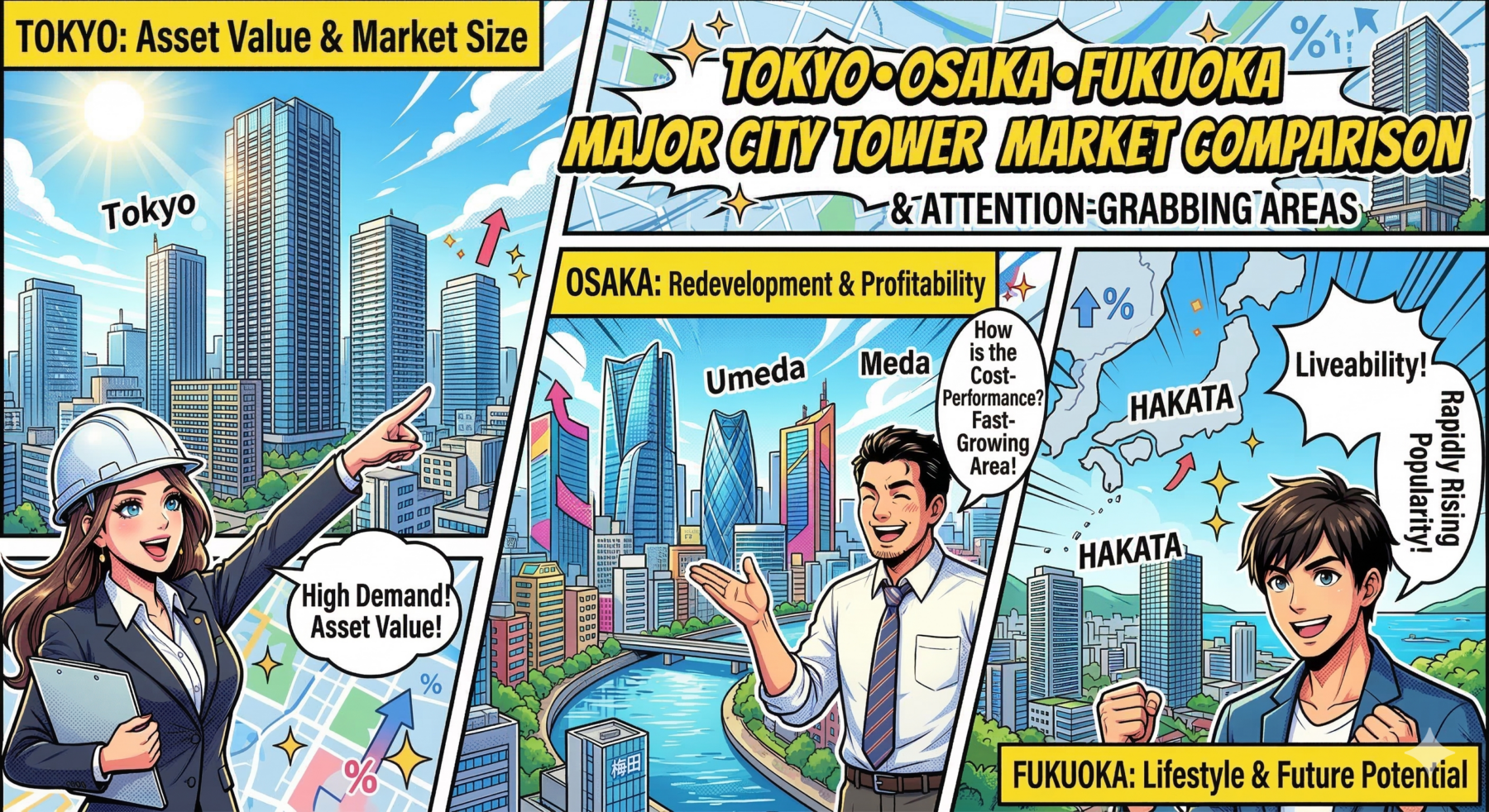
When considering tower mansion investment, choosing which city and area to invest in is a crucial decision that significantly impacts both profitability and future asset value. Japan’s three major metropolitan areas — Tokyo, Osaka, and Fukuoka — each offer distinct market characteristics and investment opportunities. This article compares the current state of the tower mansion market in each city and highlights the most promising areas for foreign investors.
## 1. Tokyo: Japan’s Largest Tower Mansion Market
Tokyo is the epicenter of Japan’s tower mansion market, with approximately half of all tower mansion units nationwide concentrated in Tokyo. Overwhelming population scale, business agglomeration, and continuous redevelopment sustain robust demand.
Tokyo’s market is characterized by an extremely wide price range across areas. In the central three wards of Minato, Chiyoda, and Chuo, new tower mansion prices per square meter commonly exceed 2 million yen, with some reaching over 7 million yen per tsubo. In contrast, waterfront areas and surrounding wards offer relatively more accessible price points.
Rental yields for high-priced central properties tend to remain at 3% to 4%, but when considering stable rental demand and asset value retention, the total return including capital gains remains attractive.
### Key Area 1: Waterfront Area (Chuo, Koto, Minato Wards)
Tokyo Bay’s waterfront is Japan’s largest concentration of tower mansions. Districts such as Harumi, Toyosu, Ariake, and Shibaura feature numerous tower developments with large-scale urban development underway.
With the Harumi Flag development welcoming residents from 2024, the waterfront’s residential population continues to grow. Commercial and educational facilities are expanding, transforming the area from a bedroom community into a self-sustaining urban district.
For investors, the high supply volume means property differentiation is key to rental competitiveness. Select properties with superior views, floor levels, and shared facilities. Areas benefiting from BRT systems and subway extension plans offer potential for improved convenience and value appreciation.
### Key Area 2: Shinagawa and Takanawa Gateway
The Shinagawa Station area hosts one of Tokyo’s largest redevelopment projects. The Takanawa Gateway Station, opened in 2020, anchors a redevelopment creating an integrated urban space combining office, commercial, residential, and cultural facilities.
As the planned terminus for the Linear Chuo Shinkansen, Shinagawa Station will see dramatically improved access to Nagoya and Osaka, strongly supporting medium- to long-term asset value appreciation. New tower mansion supply is planned, making early information gathering and investment decisions essential.
### Key Area 3: Shibuya and Shinjuku
Both Shibuya and Shinjuku stations continue to undergo large-scale front-of-station redevelopment. Shibuya’s development centers on Shibuya Scramble Square, while Shinjuku’s west exit redevelopment plans are advancing.
These areas represent Japan’s premier business and commercial districts with sustained high rental demand. Limited tower mansion supply creates strong scarcity value. However, high acquisition costs make these areas more suitable for investors prioritizing capital gains over yield.
## 2. Osaka: Growth Potential with Favorable Cost Balance
Osaka’s tower mansion market is distinguished by lower acquisition costs compared to Tokyo and relatively higher rental yields. International attention has grown following the Osaka Expo, with further growth anticipated.
Osaka’s tower mansions concentrate in the central wards of Kita, Chuo, Nishi, and Fukushima. New construction prices per square meter run roughly half to two-thirds of central Tokyo levels, with gross yields of 4% to 6% achievable. For foreign investors, the ability to achieve high yields with lower initial investment is highly attractive.
### Key Area 1: Umeda and Nakanoshima (Kita Ward)
Umeda, centered on JR Osaka Station, is western Japan’s largest terminal area with multiple major redevelopments in progress. Grand Front Osaka and the Umekita Phase 2 project are significantly expanding office, commercial, and residential functions.
The Nakanoshima area, anchored by the Festival Tower, has established itself as Osaka’s business center. Tower mansions leveraging the beautiful riverside scenery combine high residential satisfaction with stable rental demand.
### Key Area 2: Yumeshima and Sakishima (Konohana and Suminoe Wards)
Yumeshima, host of the 2025 Osaka Expo, is also being considered as the site for an Integrated Resort (IR). If the IR materializes, job creation and increased tourism could substantially boost real estate demand in surrounding areas.
While residential development has not yet fully commenced, early property acquisition in surrounding areas from a medium- to long-term investment perspective could yield significant returns. Monitor transportation infrastructure developments closely to optimize investment timing.
### Key Area 3: Honmachi and Shinsaibashi (Chuo Ward)
The Honmachi area, adjacent to the commercial and tourism hub of Shinsaibashi and Namba, combines business and lifestyle convenience as a popular residential district. Excellent access along the Midosuji subway line and surrounding commercial facilities attract tenants consistently.
Tower mansions in this area benefit from strong demand from business professionals and foreign expatriates, supporting stable rental operations. Slightly lower acquisition costs compared to the Umeda area enhance investment efficiency.
## 3. Fukuoka: Japan’s Fastest-Growing City
Fukuoka continues to record the highest population growth rate among Japan’s major cities, with real estate market growth potential that stands out even among the three major metropolitan areas. Its compact city design, proximity to Asia, and high quality of life support domestic and international population inflows.
Fukuoka’s tower mansion market offers the lowest acquisition costs compared to Tokyo and Osaka, with gross yields of 5% to 7% achievable for some properties. While market scale has not yet matched Tokyo or Osaka, its growth rate and investment efficiency are highly attractive to foreign investors.
### Key Area 1: Tenjin and Tenjin Big Bang Area (Chuo Ward)
Fukuoka’s largest commercial district, Tenjin, is undergoing the “Tenjin Big Bang” — a major redevelopment project. Relaxed floor area ratios accompanying building reconstruction are accelerating high-rise and tower mansion construction.
Tower mansions in Tenjin offer the advantage of having commercial facilities, restaurants, and transportation all within walking distance. The area’s good access to Fukuoka Airport makes it particularly popular with business travelers.
### Key Area 2: Hakata Station Area (Hakata Ward)
Hakata Station, served by both Shinkansen and subway, is Fukuoka’s gateway. The “Hakata Connected” project is driving active redevelopment around the station, with mixed-use tower mansion developments planned alongside office buildings.
The area boasts exceptional access to Fukuoka Airport — just 5 minutes by subway — and its role as a gateway for domestic and international business travelers and inbound tourists continues to strengthen.
### Key Area 3: Momochihama and Jigyohama (Sawara Ward)
The Momochihama and Jigyohama coastal area, home to Fukuoka Tower and PayPay Dome, is one of Fukuoka’s most popular residential districts. It combines an open seaside environment with good access to Tenjin and Hakata.
Family demand is particularly strong, with the area’s educational environment highly rated. Tower mansions offer Hakata Bay views, and upper-floor units tend to maintain strong asset values due to their scarcity.
## 4. Investment Indicator Comparison Across Three Cities
For investment reference, here is a comparison of key tower mansion investment indicators across the three cities.
Regarding acquisition price, central Tokyo is the highest, central Osaka runs roughly 60% to 70% of Tokyo levels, and central Fukuoka approximately 40% to 50%. Investors seeking to minimize initial capital will find Osaka and Fukuoka more suitable.
Gross yields show an inverse relationship to acquisition costs: 3% to 4% in central Tokyo, 4% to 6% in central Osaka, and 5% to 7% in central Fukuoka. Income-focused investors will find Osaka and Fukuoka more advantageous.
Rental demand stability is strongest in Tokyo, with the deepest tenant pool and greatest resilience to economic fluctuations. Osaka’s stability has improved through inbound tourism and corporate agglomeration, while Fukuoka’s strength lies in population-growth-driven consistent demand.
For asset value appreciation potential, Tokyo offers stable value maintenance, Osaka benefits from IR plans and Expo spillover effects, and Fukuoka’s population growth and redevelopment projects drive the strongest growth potential.
## Conclusion
Tokyo, Osaka, and Fukuoka each form distinct tower mansion markets with different investment appeals. For stability and liquidity, choose Tokyo. For a balance of yield and growth potential, consider Osaka. For the highest growth rate and investment efficiency, Fukuoka stands out. In all three cities, focusing on areas with ongoing redevelopment and making investment decisions informed by future development plans and infrastructure progress is the key to long-term investment success.