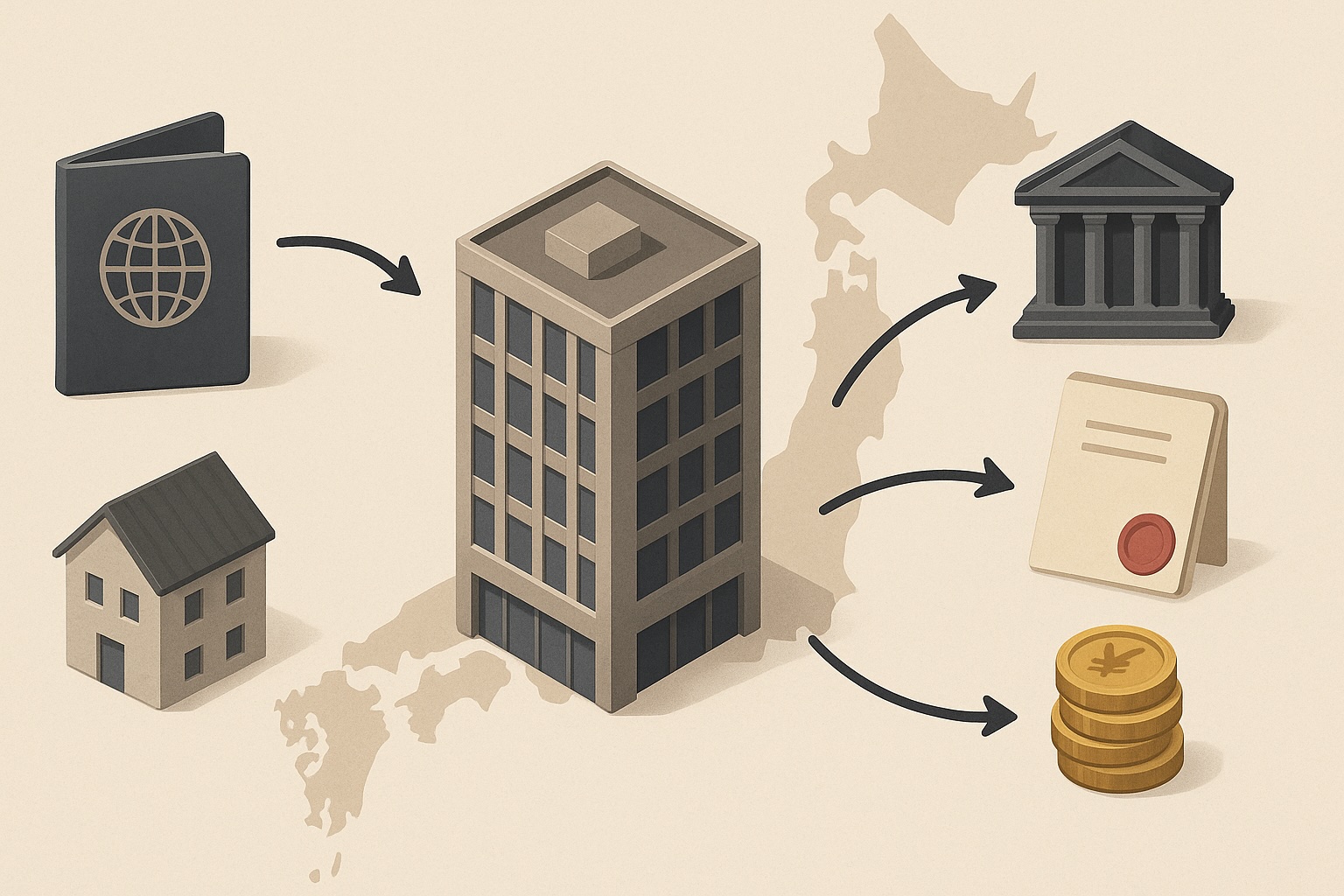
Holding property in your personal name can limit financing options and complicate taxes or inheritance. Establishing a dedicated company is a proven way to solve these issues. Below is a concise guide covering why to incorporate, how to choose between a Godō-Kaisha (GK) and a Kabushiki-Kaisha (KK), and what the registration process looks like in practice.
1. Why Incorporate?
Risk Containment – Liability stays within the company.
Tax Flexibility – Broader deductible expenses and loss carry-forwards.
Better Financing – Banks prefer lending to legal entities; joint-investment structures are easier.
Smooth Succession – Transfer shares instead of property titles, saving cost and time.
2. Choosing Between GK and KK
GK: fast and cost-efficient
No notary certification, roughly ¥100,000 to set up.
Flexible governance; members design rules via the articles.
KK: higher credibility and fundraising capacity
Formal board structure boosts confidence with lenders and partners.
Financial statements must be disclosed annually, but online disclosure keeps costs low.
3. Step-by-Step Timeline
①Decide company name, address, capital, and business purpose.
②Draft Articles of Incorporation—adding English clauses helps international stakeholders.
③Notary certification (KK only).
④Deposit capital; though ¥1 is legal, ¥1 million+ smooths bank screening.
⑤File registration with the Legal Affairs Bureau; processing takes about a week.
⑥Open a bank account—prepare strict UBO documentation, passport, and entry stamps.
4. Representative Address & Residence Status
A representative director can reside outside Japan, but banks and tax offices prefer a domestic point of contact. Those seeking a Business Manager visa should budget roughly ¥5 million in capital and secure an office lease.
5. Common Pitfalls
Omitting “sale, lease, and management” from the business scope, leading to costly amendments.
Relying on the two-year consumption-tax exemption and overlooking revenue thresholds.
Engaging advisers without cross-border real-estate experience, prolonging the process.
6. Mini-Case
An investor established a ¥3 million GK in Osaka to operate a licensed short-stay property. Clear inclusion of “hotel operations & real-estate management” in the articles and proactive cash-flow tracking resulted in a post-tax net yield above 5 %.
Takeaway
Incorporation isn’t an expense—it’s an investment in risk mitigation and tax efficiency. Start lean with a GK and consider migrating to a KK as your portfolio grows.